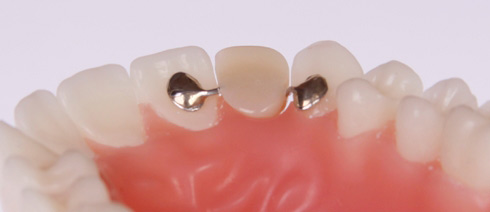
Provisional three unit bridge

7 Dec 2017

What is a three unit provisional bridge?

A bridge is a dental prosthesis uses to close, or bridge, the gap of a missing tooth. It is the adjoinment of two or more teeth, with the abutments on the first and last teeth. To comfortably fit the bridge in the mouth, the enamel must be removed on the abutments. The artificial teeth that fill the space of the missing ones are called pontics. A three unit provisional, or temporary bridge, is a type of bridge with two abutments and a pontic between them that is made of composite materials rather than ceramic, feldspar, single or disilicates, or zirconium as is used in other types of bridges.

Although uncommon, it is only used when waiting for a permanent bridge to be made from the lab.


Cantilever bridge

6 Dec 2017

What is a cantilever bridge?

A cantilever bridge is a type of dental bridge which only contains one abutment and crown, and one pontic in the toothless gap. This is shown in the image on the left. The artificial teeth that fill the space of the missing ones are called pontics. The abutment is the tooth on the edge which supports the bridge. To comfortably fit the bridge in the mouth, the enamel must be removed on the abutments.


Three unit Maryland bridge

6 Dec 2017

What is a Maryland bridge?

Maryland bridges are a cheaper alternative to traditional bridges. The pontic is held in place by a metal or porcelain framework with stretches to the two adjacent teeth, as shown in the picture on the left. The artificial teeth that fill the space of the missing ones are called pontics. The framework is bonded on the back of the teeth so as to not impact regular chewing and to keep the mouth aesthetically pleasing. Because of this, the two teeth on the side of the pontic do not have to have their enamel removed.


Conventional three unit bridge

6 Dec 2017

What is a conventional bridge?

Maryland bridges are a cheaper alternative to traditional bridges. The pontic is held in place by a metal or porcelain framework with stretches to the two adjacent teeth, as shown in the image on the left. The artificial teeth that fill the space of the missing ones are called pontics. The framework is bonded on the back of the teeth so as to not impact regular chewing and to keep the mouth aesthetically pleasing. Because of this, the two teeth on the side of the pontic do not have to have their enamel removed.

Removal of a loose indirect restoration and Recementation

6 Dec 2017

What is an indirect restoration?

The removal of a currently cemented definitive indirect restoration, which may be subsequently reinserted.

Crowns, inlays and onlays are all examples of indirect restorations. Indirect restorations are created or milled externally using our CEREC MCXL Unit and then placed in the mouth, while direct restorations such as fillings are directly placed and light cured within the mouth.


Lab based Crown On a Root Canal Treated tooth

6 Dec 2017

What is a root canal?

A root canal is a dental procedure to repair damaged or infected teeth. It involves the removal of the dental pulp within the tooth, followed by the cleansing and disinfection of the root canal. Then, clean rubber-like dental material is inserted into the canal and sealed. Common causes for damaged pulp include cracked teeth, deep cavities, or repeated treatment to a specific tooth.

Why is a lab based crown added?

A crown may be added a few weeks after the treatment as it is made in the lab. This is because the treated tooth has lost its pulp, it cannot function as a living thing, and it will eventually weaken. The crown strengthens the tooth and protects it form bacteria.

Cerec Crown On a Root Canal Treated tooth

6 Dec 2017

What is a root canal?

A root canal is a dental procedure to repair damaged or infected teeth. It involves the removal of the dental pulp within the tooth, followed by the cleansing and disinfection of the root canal. Then, clean rubber-like dental material is inserted into the canal and sealed. Common causes for damaged pulp include cracked teeth, deep cavities, or repeated treatment to a specific tooth.

Why is a CEREC crown added?

A crown may be added in the same visit when it is milled within minutes by our CEREC MCXL Milling Unit because, as the treated tooth has lost its pulp, it cannot function as a living thing, and it will eventually weaken. The crown strengthens the tooth and protects it from bacteria.


Cerec Crown

6 Dec 2017

What is a CEREC crown?

The use of in-house CEREC technology eliminates the need for dental prostheses to be sent and made in a lab, which could take days, or even weeks before they are ready for the patient. It also eliminates the need for a physical dental impression, in which you have to bite down on a gooey putty for several minutes. The CEREC uses a digital impression to mill the crowns, as shown in the image on the left. The use of the Sirona Orthophos XG5 3D X-ray machine, CEREC Omnicam, and CEREC MCXL Milling Unit enables the precise creation and placement of any prosthesis in a single visit.

Search

+